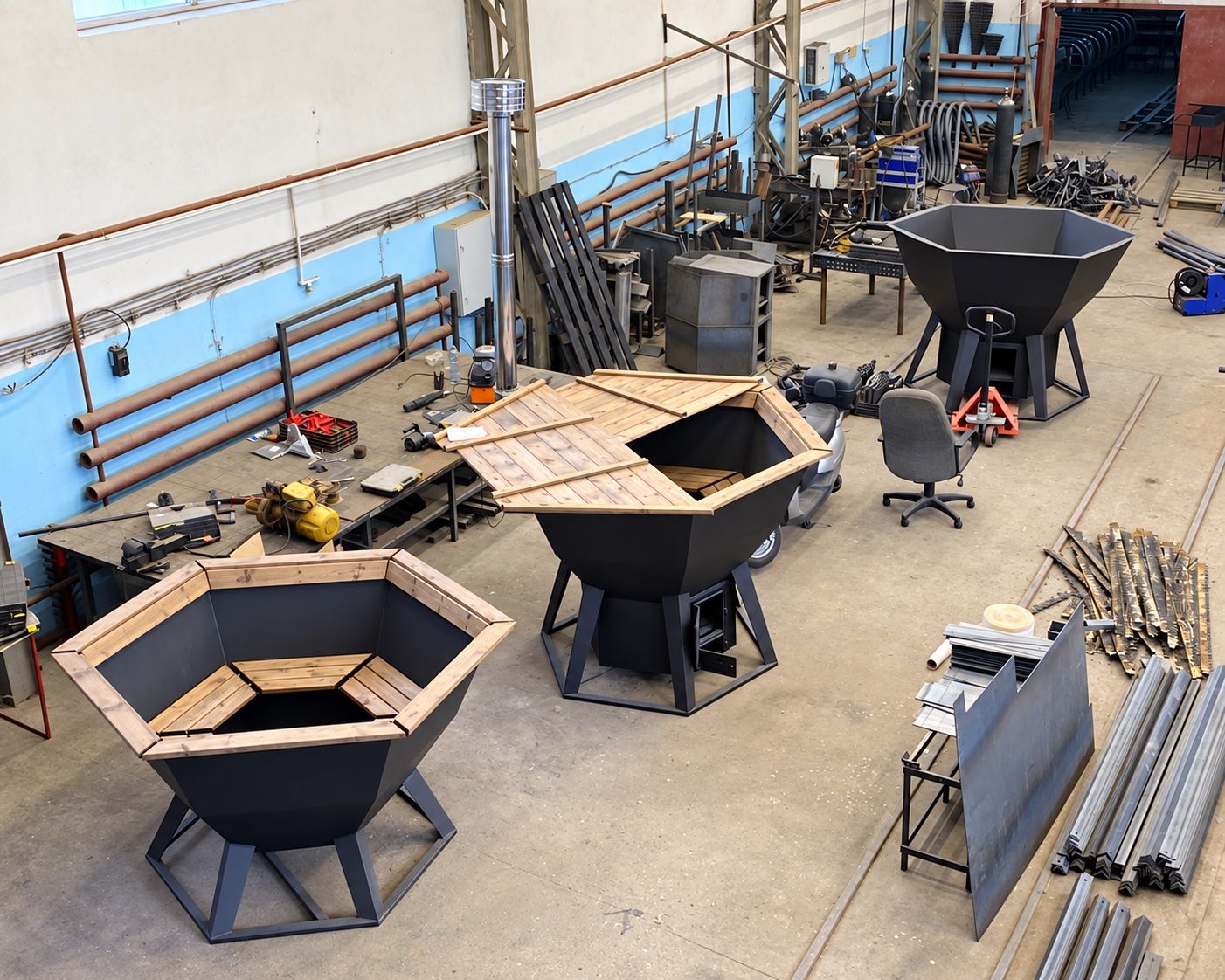
A hot tub is a simple object. A tank that holds water, a fire underneath, a pipe to carry the smoke away. Almost everything that decides whether it lasts ten years or thirty happens before it ever sees water — in the steel, the welds, and the fit.
Here’s the order we build in.
It starts with the steel
Every tank begins as a flat sheet of AISI 304 stainless steel, 2 mm thick. 304 is the everyday food-grade stainless: the same family used for kitchen sinks and brewing tanks. It holds up to heat, wet, and cold without rusting, which is what a tub that sits outdoors through a winter needs.
The sheet is cut by laser, bent on a CNC press, and welded with a semi-automatic laser weld. That’s three machines doing work that can be done by hand — and the reason we use them is leaks.
A tub is a vessel that gets heated and cooled hundreds of times, with a few hundred gallons pushing on every seam. Cutting and bending to a tolerance a machine can hold means the edges meet exactly where they should, and the weld has nothing to bridge. In our experience, tubs made with simpler tooling leak often enough to matter — around one in five. With this process, we’ve made leaks a rare event rather than a risk you accept. It’s also why we can back every tank with a 10-year leak warranty — the tolerance is built in at this stage, not patched in later.
The firebox goes underneath
On every model, the fire sits beneath the tank floor rather than inside the tub. That keeps the inside of the tub clear — water, seats, and people, with no firebox to fence off — and it means the tank floor itself is the heat exchanger.
The three models handle the fire differently:
- Siberia Junior — an open hearth under the tank, insulated by the stand.
- Siberia Medium — a grate-fired stove that draws air from below, so it catches quickly and burns evenly.
- Siberia Large — a water jacket that wraps around the firebox, so water is in contact with nearly the whole surface of the fire. Nothing runs through the walls of the tub; the shape of the stove is simply designed to put as much water against as much hot metal as possible. In a bigger tub, that’s what keeps the heat-up time close to the smaller models’.
Depending on the model, the firebox is welded to the tank or bolted to it. Either way the joint is made to stay put for the life of the tub.
The flue kit is stainless steel and leaves at the side.
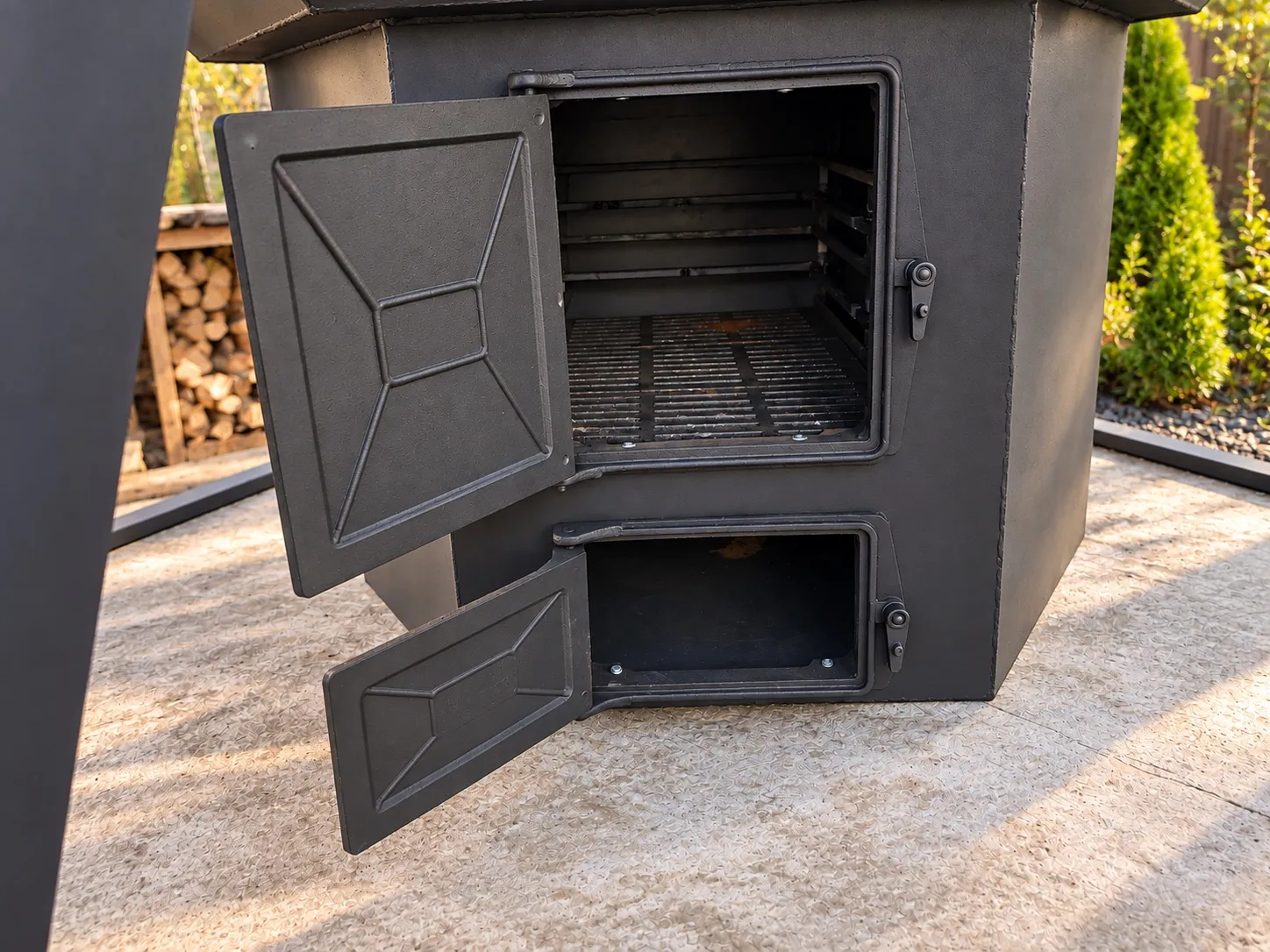
The firebox on a Siberia Large: a grate for the fire, a drawer for the ash, each with its own door.
Paint, and why only on the outside
The stove and frame get a black heat-resistant finish. Inside the tank there’s no coating at all: bare stainless. Nothing to blister, peel, or end up in the water — you clean it the way you’d clean a steel sink.
Cedar goes in last
Cedar is the part you actually touch, so it goes in after the steelwork is done: the floor, the seating, the trim, and the accessories. The wood is finished and treated against rot and weather.
The floor lifts out, and the seat boards can be replaced. That matters more than it sounds. Wood in a tub that’s used all year will eventually want attention. On ours, you take it out, dry it, and put it back — or fit a new board, rather than living with a worn one.
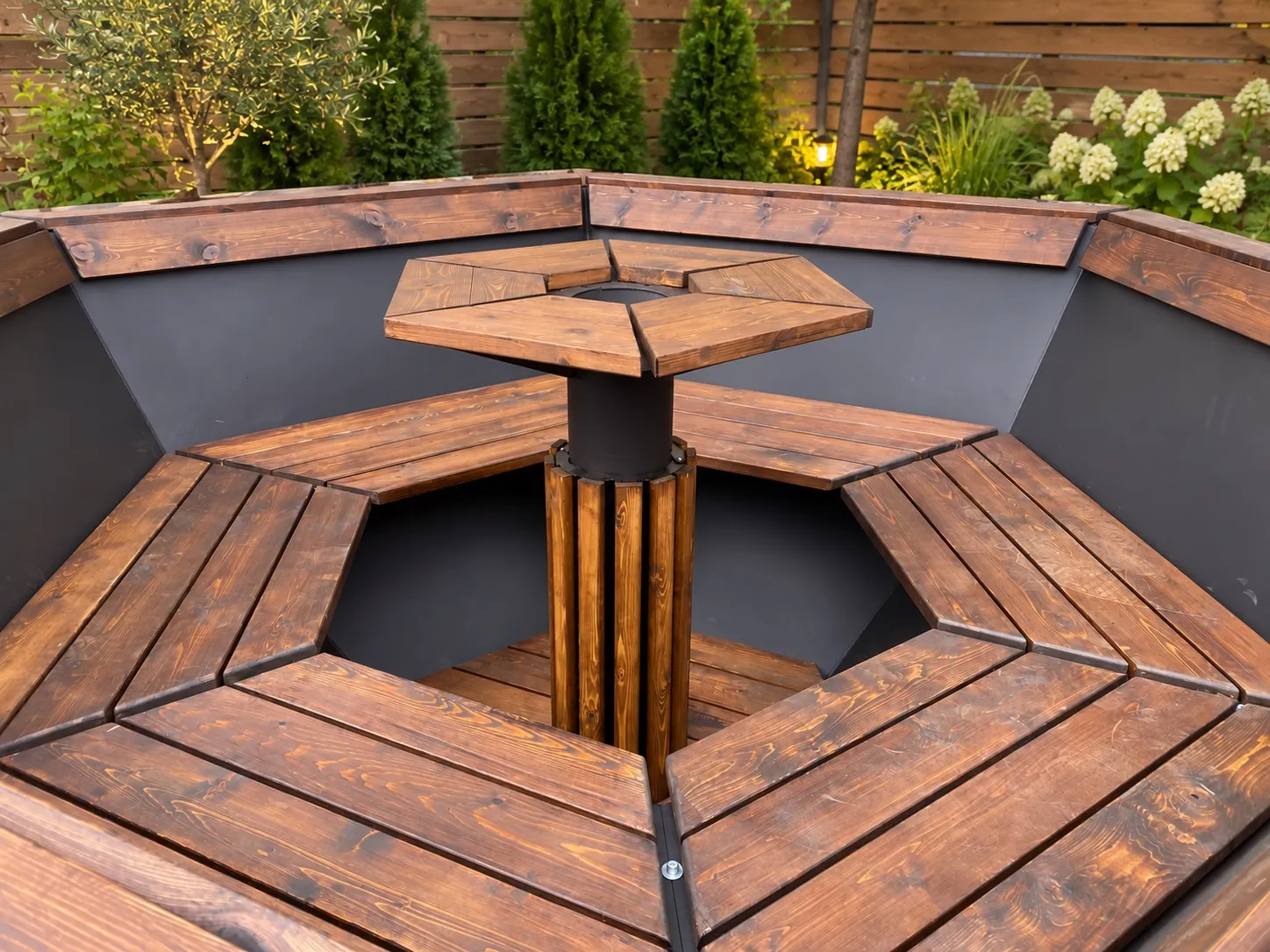
The cedar bench and centre table inside a Siberia Large, fitted once the steelwork is done.
What we test, and how
Every new model goes through a long test before it’s built for customers, and the thing we test for is leaks.
We use the tub the way an owner would. Different water at the inlet, warm and cold. Fires fed hard and fires left to idle. Heat-up after heat-up, then left to stand cold. We look for leaks both hot, when the steel has expanded, and cold, when it has pulled back.
The design has five years behind it, and the tubs have been through several seasons of real use in between. Most of what’s in the design now is there because an earlier version taught us something.
Fittings
Last come the parts you’ll use every time: a 1-inch brass drain valve, and a thermometer built into the wall so you can read the water without a floating gauge.
What we build alongside the tub
The accessories are made in the same workshop, from the same cedar:
- A lid. It keeps leaves, dust, and rain out between soaks, and it holds heat in.
- Ladders, in more than one shape — a simple wooden one comes with the tub, and a larger steel-and-cedar step ladder is available if you want a more solid climb.
- A table that attaches to the rim.
- A paddle. More useful than it sounds. Hot water collects near the bottom, so you stir before getting in. It’s also what you use to mix in anything you add for scent — pine or spruce sprigs, citrus, herbs.
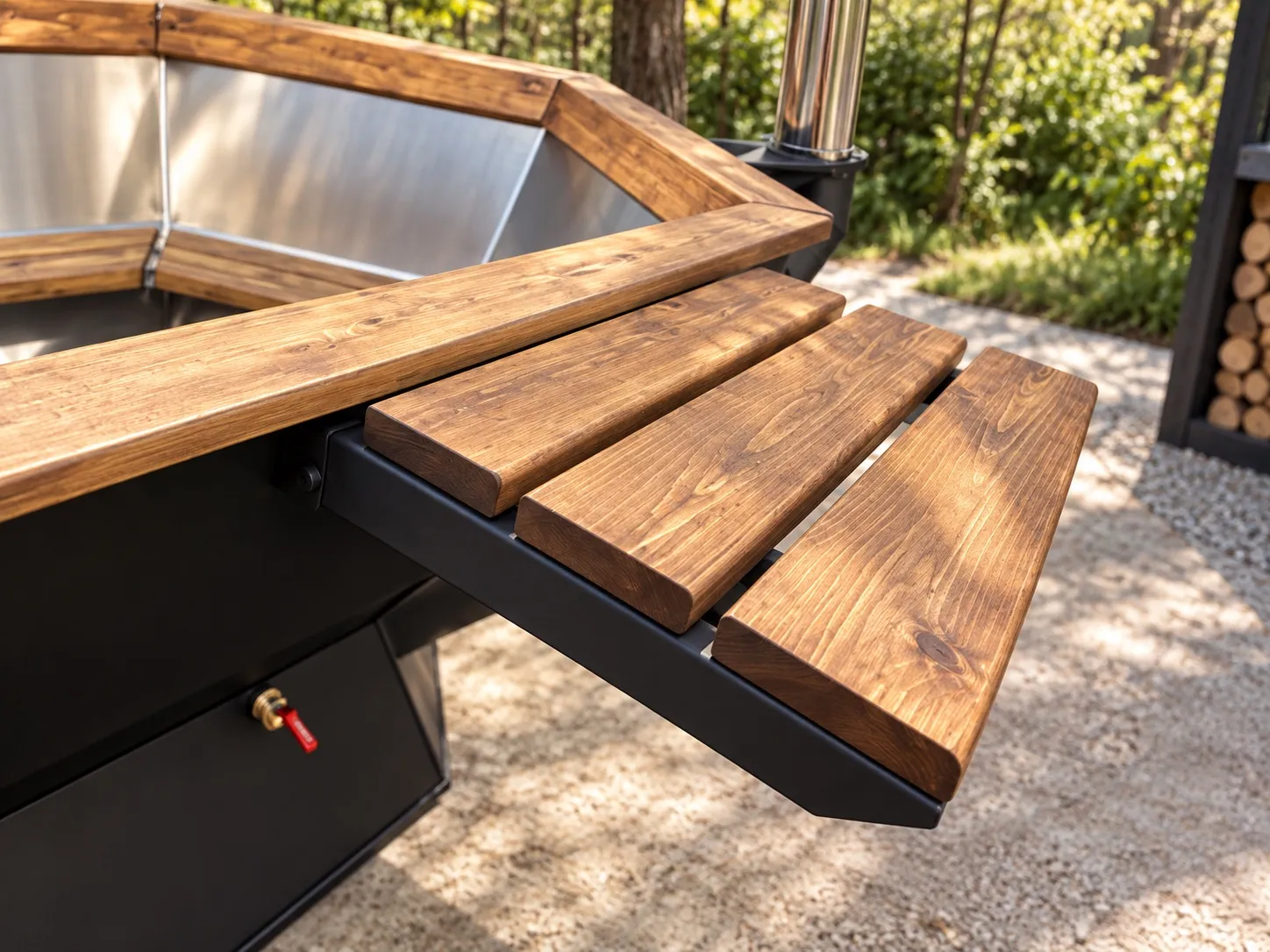
The attachable table, clipped to the rim — no clamps or tools needed.
What all this means once it’s yours
A tub built this way has very little to go wrong. There’s no pump, no heater element, no control board — the parts that fail first on an electric tub simply aren’t there. What’s left is a stainless tank, a firebox, and wood you can lift out and replace.
That’s the reasoning behind the 10-year leak warranty, and behind building the tank out of 2 mm 304 in the first place.
If you want to see the result rather than the process, the models are here. And if you’re weighing wood against steel, we cover that in the complete guide.