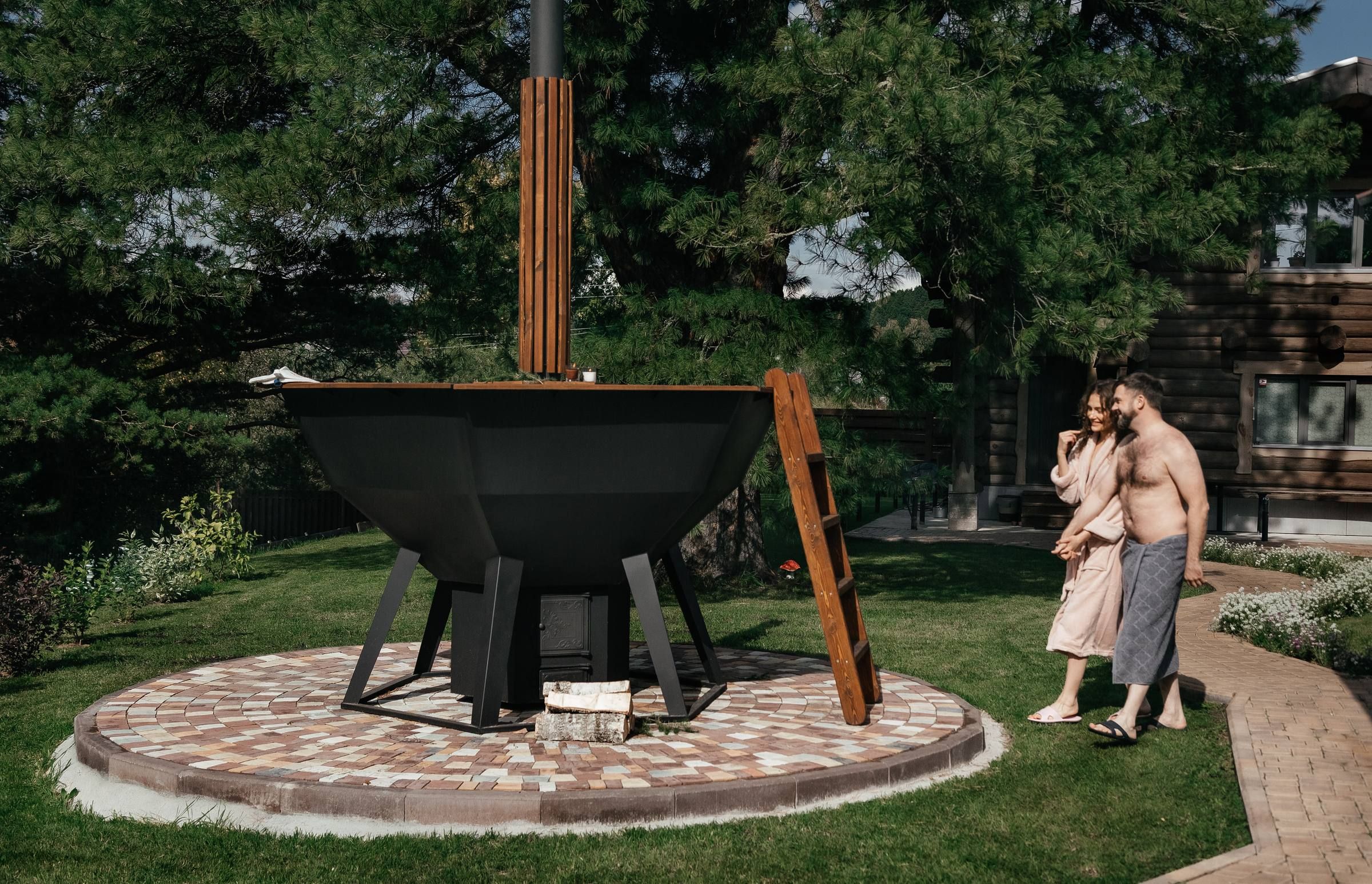
A wood-fired hot tub is a tub of water heated by a wood stove. It needs no electricity, no pump, and no plumbing beyond a hose to fill it and a valve to drain it. You light a fire, wait a few hours, and the water comes up to soaking temperature. That’s the whole idea — and most of what follows is about doing it well.
In short
- Heat-up: 2–5 hours, depending on the tub’s size, the stove, and the weather.
- Power: none. The fire does the heating; the water moves by itself as it warms.
- Water: usually changed every few soaks, not treated for months like an electric tub.
- Materials: cedar, stainless steel, or aluminum — each with real trade-offs.
- Price: roughly $3,000 to $13,000+ in the US in 2026.
What a wood-fired hot tub is
You’ll see three names for the same thing: wood-fired hot tub, wood-burning hot tub, and wood stove hot tub. All mean a tub heated by burning wood, not by an electric element.
The idea is old. Japanese households have soaked in wood-heated ofuro tubs for centuries, and wood-heated outdoor tubs are a long tradition across the Nordic countries. What has changed is the materials: stainless steel and marine-grade aluminum now sit alongside the classic cedar barrel.
What a wood-fired tub is not is a quieter version of an electric hot tub. There are no jets, no filter running in the background, and no thermostat holding the water at 102°F all week. You heat it when you want to use it. For many owners, that’s the point.
How it works
Fire heats water, water moves itself
A stove burns wood next to — or under — a body of water. Heat passes through the stove’s metal walls into the water around it. Warm water is lighter than cold water, so it rises and cooler water sinks to take its place. This slow loop, called natural circulation or thermosiphon, spreads heat through the tub without a pump.
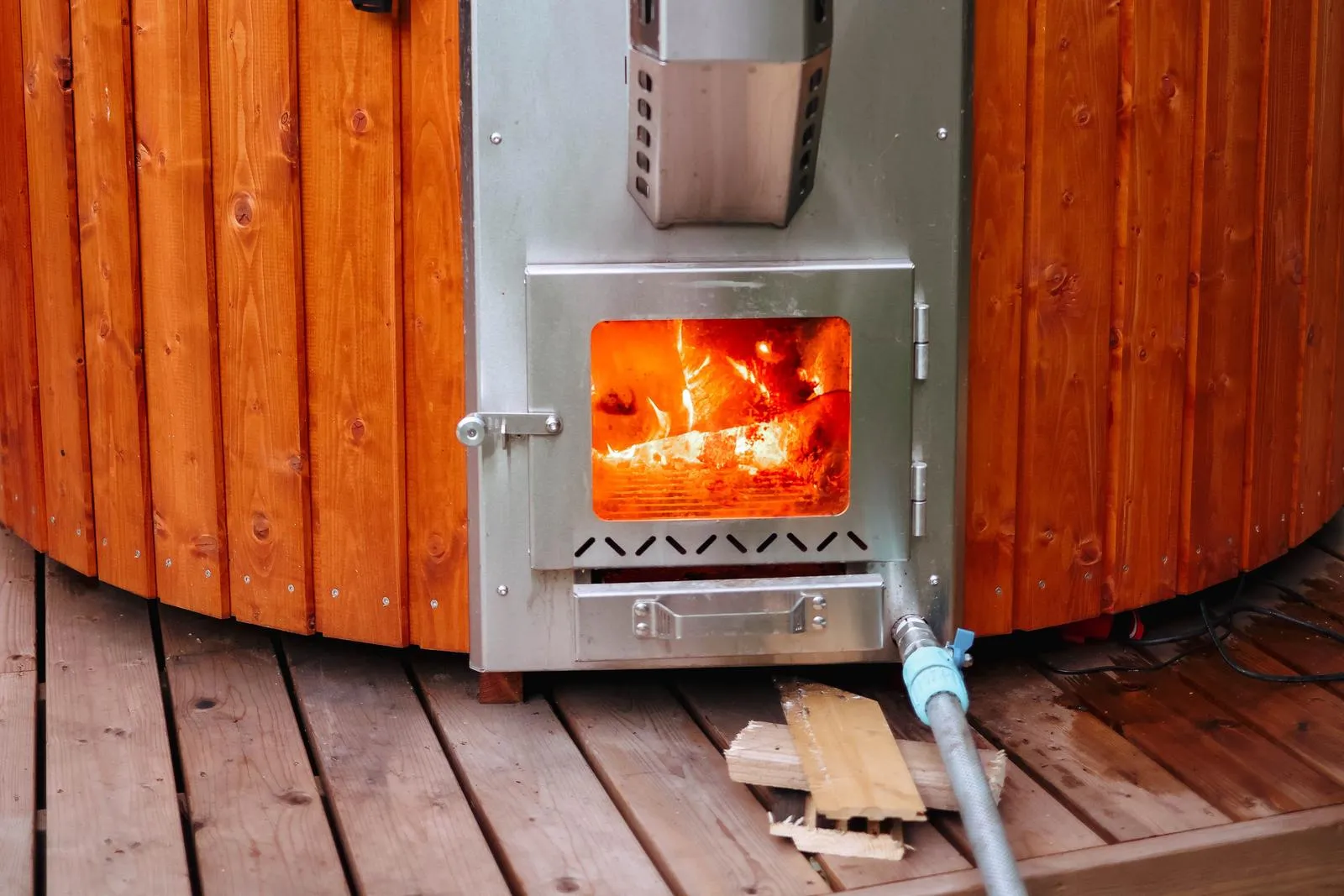
A wood stove built into the side of a tub: the fire heats the water through the stove’s metal walls.
It isn’t perfectly even. The top layer warms first, so you stir the water with a paddle before getting in. A thermometer tells you where you are.
Three stove designs
Every wood-fired tub uses one of three layouts. Each works; they suit different people.
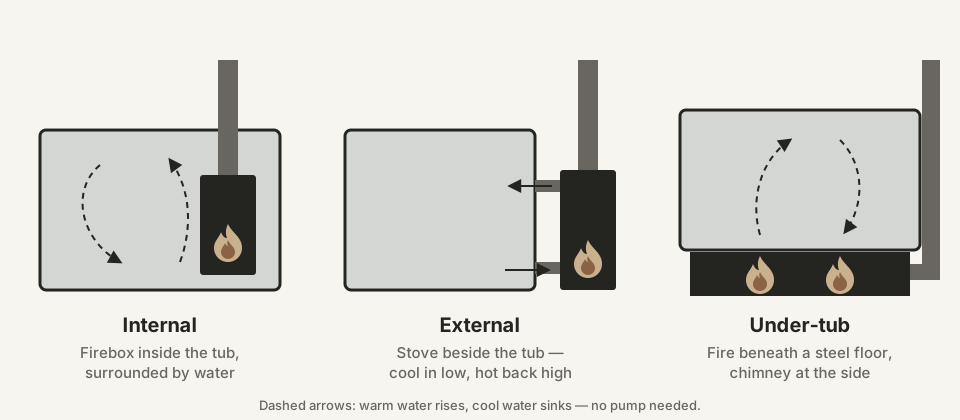
The three stove layouts side by side. In each, warm water rises and cool water sinks.
| Design | Where the fire is | Good at | Watch for |
|---|---|---|---|
| Internal | A firebox sits inside the tub, surrounded by water | Efficient: almost all heat goes into the water | Takes seating space; needs a guard between bathers and the stove |
| External | A separate stove beside the tub, connected by two pipes | Frees the whole tub for seating; stove easy to reach | Loses some heat outside the tub; pipes need draining in winter |
| Under-tub | The fire burns beneath the tub’s floor | Nothing in the water but people; clean inner space | Needs a heat-resistant floor — steel, not wood |
An under-tub fire only works with a metal tub: the floor has to carry the heat. It’s the design we build all our tubs around. Inside the tub there’s nothing but water, seats, and people — no firebox to fence off or bump into. The firebox differs by model: the Siberia Junior has an open hearth, the Siberia Medium a grate-fired stove, and the Siberia Large has an under-tub stove with a water circuit: the firebox is almost completely surrounded by water, so nearly all of its heat goes into the water, much like an immersion stove.
Controlling the temperature
There’s no dial. You control heat the way you would with a campfire:
- More wood, open air intake — the water heats faster.
- Fewer logs, air intake nearly closed — the fire idles and holds the temperature.
- Let it burn down — the water starts to cool almost at once.
Most people light the fire, check the thermometer every half hour, and stir as it gets close. Once the water is ready, don’t let the fire go out: keep a small, steady fire under the tub while you soak, and feed it a log when the water starts to drop. After a few sessions, you’ll know your tub.
How long it takes to heat
Most wood-fired tubs reach soaking temperature in 2 to 5 hours. The four things that decide where you land:
- Volume. More water takes longer. A 300-gallon tub and a 650-gallon tub are different projects.
- Starting water temperature. Water from a hose in January can be 20–30°F colder than in July. That difference alone can add an hour or more.
- Wind and air temperature. Wind strips heat from the surface. A lid cuts heat loss more than anything else you can do.
- Wood. Dry hardwood burns hotter and steadier than damp or soft wood.
Here’s what makers publish for their own tubs. Few state the starting water temperature, so treat this as a rough guide, not a race.
| Tub size | Typical stated heat-up | Examples |
|---|---|---|
| ~150–300 gal | 1.5–4 hours | Two-person soaking tubs, compact barrels |
| ~300–450 gal | 1.5–3 hours | Four- to five-person tubs |
| ~600–650 gal | 3.5–5 hours | Six- to eight-person tubs |
In our own tests at 5°F (-15°C), the Siberia Large — 634 gallons — came up from cold water in 2 to 4 hours. The spread came almost entirely from how hard we fed the fire. So we quote 3 hours as a fair average for all three of our models. For a tub that size, that’s quick: the published figures we found for 600–650-gallon tubs run 3.5 to 5 hours, and most don’t say how cold it was outside. In summer, expect it to be faster.
A practical tip: light the fire before you start dinner. By the time you’ve eaten, the tub is ready.
Wood or steel: choosing the tub itself
This is the biggest choice you’ll make, and it shapes everything after it — care, winter use, cleaning, and how the tub feels.
Wooden tubs
The classic wood-fired tub is a barrel of cedar staves held together by steel bands. The wood swells when wet, and that’s what keeps it watertight.
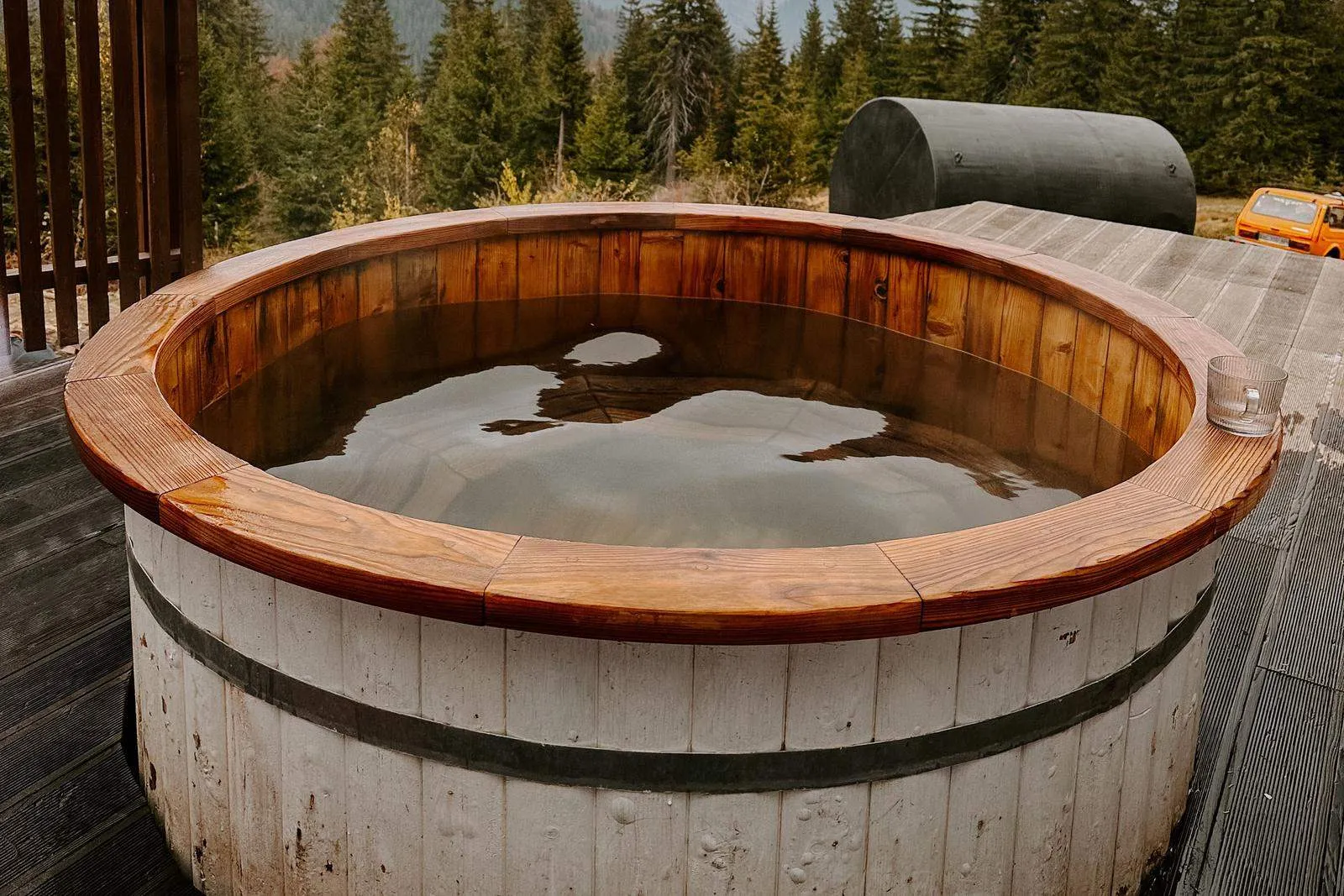
A traditional wooden tub with a cedar rim.
| Pros | Cons |
|---|---|
| The look and smell of cedar | Can’t be left empty: the wood dries, shrinks, and leaks |
| Wood itself holds some heat | A new tub leaks for days or weeks until the staves swell shut |
| Usually the most affordable on the market | Porous surface — harder to clean; algae and film settle into the grain |
| A damaged stave can be replaced | Needs regular care on the outside |
| Most sanitizers are hard on wood | |
| Lifespan estimates vary widely, from 10 to 30+ years |
Steel tubs
A steel tub is a welded stainless shell. It doesn’t depend on swelling, so it doesn’t care whether it’s full or empty.
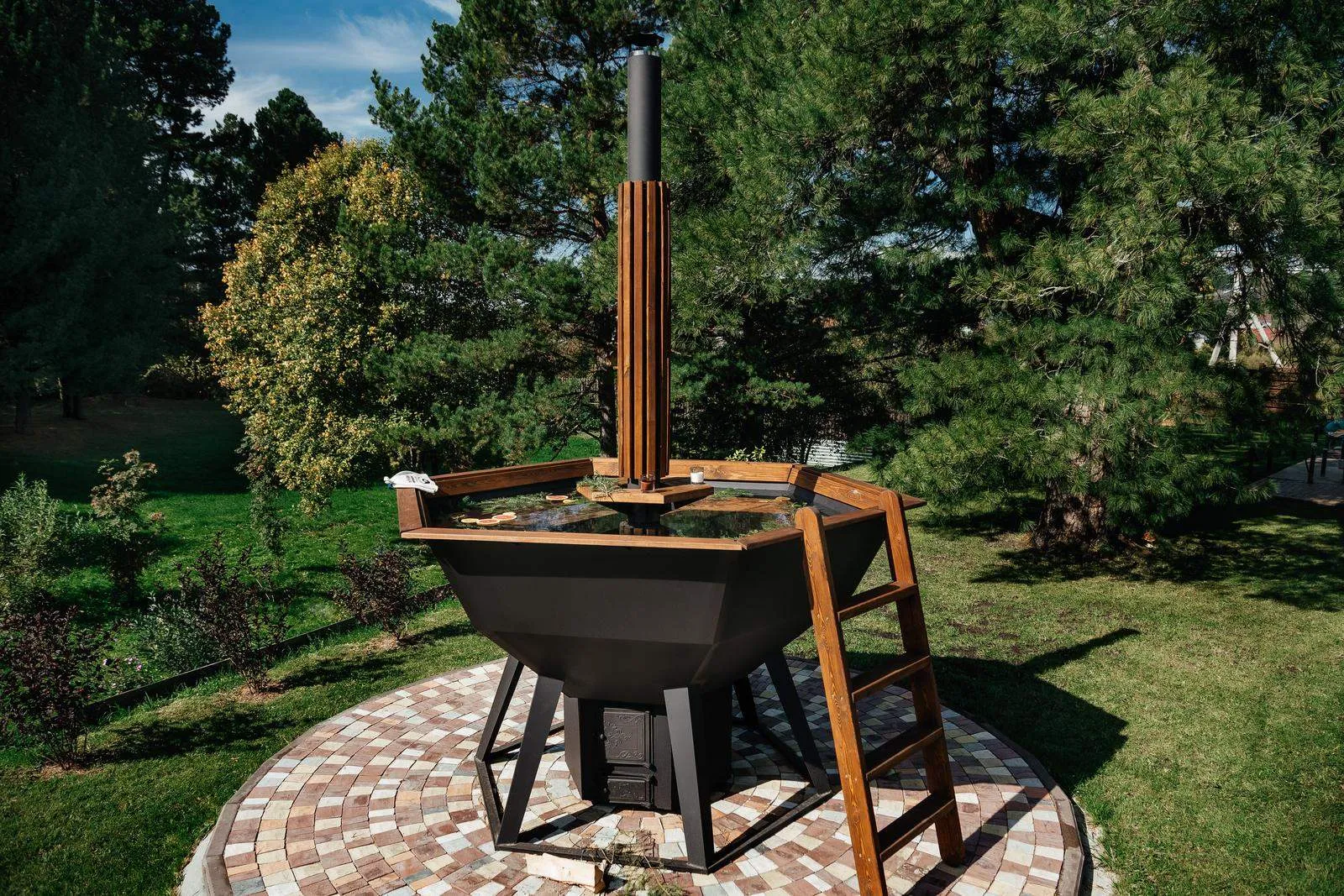
The Siberia Large: a steel body with cedar trim and the stove underneath.
| Pros | Cons |
|---|---|
| Doesn’t leak, and doesn’t need to swell first | Bare steel near the fire gets hot to the touch |
| Can sit empty and dry — useful for seasonal homes and rentals | Unless the walls are insulated, it cools faster than wood |
| Smooth surface scrubs clean quickly between uses | Wrong steel grade, or harsh chemicals, can lead to corrosion |
| Can take a fire directly under its floor | A more industrial look |
| Drained, it’s safe through a hard freeze | |
| Lasts decades with the right grade of steel |
Steel with a cedar interior
Many steel tubs, including ours, add cedar where your body meets the tub: the floor and the seats. You get a steel shell that doesn’t leak and can stand empty, and warm wood under you instead of metal.
In our tubs, the cedar floor lifts out and the seating boards can be replaced. That matters more than it sounds: you can take the wood out to scrub and dry it, and swap a board if it ever wears. The walls are uninsulated steel, so we recommend using an insulated lid between soaks — it keeps the heat in far better than any wall would.
And aluminum?
Marine-grade aluminum is the third option, used by several Canadian makers. It’s light, doesn’t rust, and conducts heat well. It’s also a softer metal than stainless steel, so it dents more easily. It sits between cedar and steel on most counts.
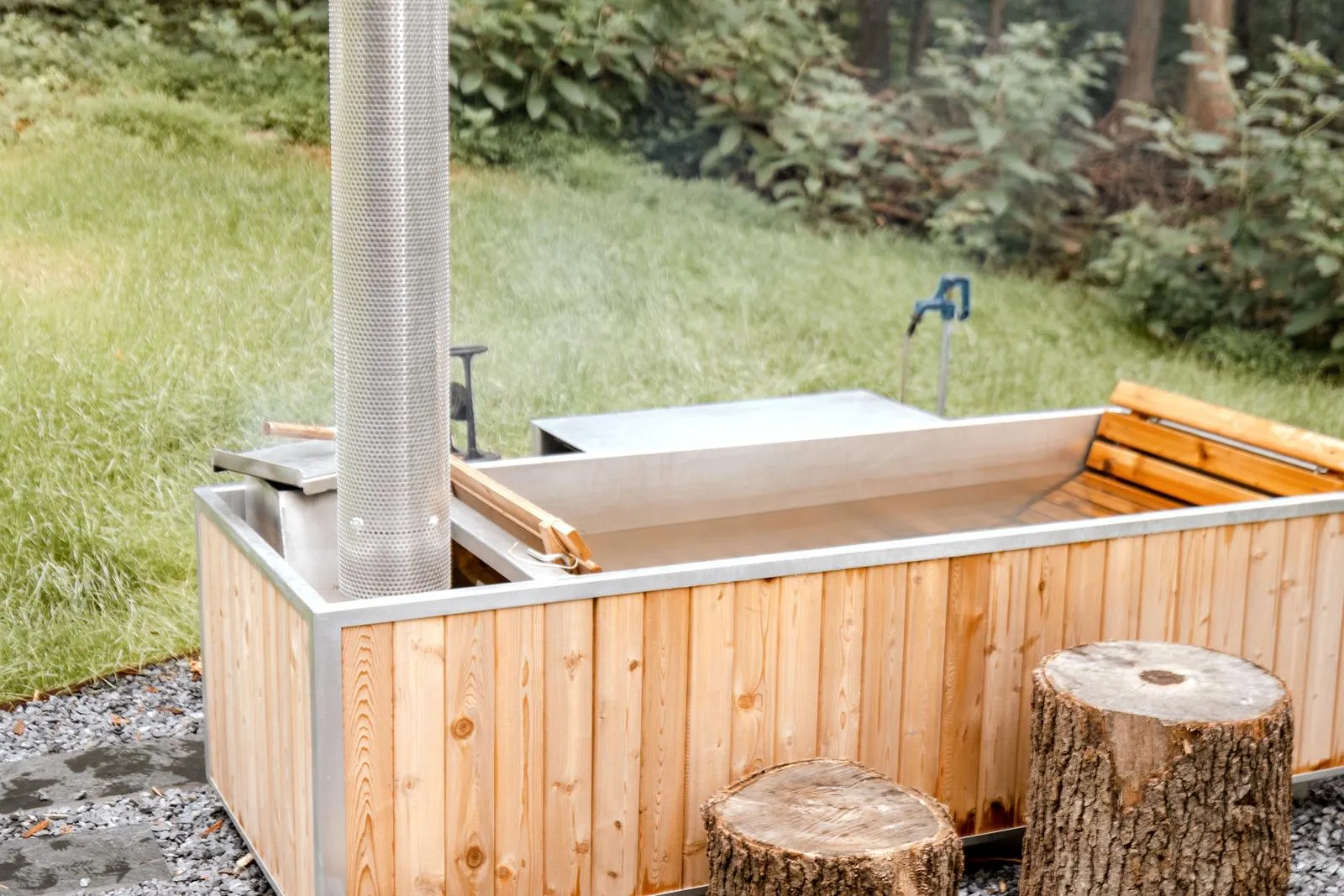
A metal tub clad in cedar, with a perforated guard around the chimney.
Why we chose steel
We came to this as users before we were makers, and we’ve soaked in cedar tubs ourselves. What we noticed came with time. Frost, thaw, rain, and dry summer air all work on wood, even the best wood. Keeping a cedar tub looking and working like new meant steady upkeep, year after year.
We looked at aluminum too. It’s lighter and it doesn’t rust, but for a tub that gets used hard, season after season, we wanted a stiffer, tougher shell. Stainless steel was the material we trusted to last the longest with the least fuss. So that’s what we build with, and we keep the cedar for the parts you touch.
Which one is for you
| If you… | Consider |
|---|---|
| Soak often, all year, and love the traditional look | Cedar |
| Use it seasonally, or leave it for weeks at a time | Steel |
| Run a rental and clean between every guest | Steel |
| Live where winters are long and hard | Steel or aluminum |
| Want the lightest tub to move into place | Aluminum or cedar |
A note on stainless steel grades
Most stainless tubs use AISI 304, the everyday food-grade stainless. Some use 316, which adds molybdenum for better resistance to salt and chlorides. For a tub filled with fresh water, 304 does the job well; 316 is the choice for salt water or near the ocean. Ours are AISI 304. We’ll cover grades in a separate post.
Wood-fired or electric
An honest comparison. Neither is better in every way.
| Wood-fired | Electric | |
|---|---|---|
| Power needed | None | Dedicated 240 V circuit for most models |
| Heat-up | 2–5 hours, each time you use it | Kept hot around the clock |
| Purchase price | Lower on average | Higher on average |
| Running cost | Firewood only | Electricity every month, plus chemicals |
| Effort | You tend a fire | Press a button |
| Jets and bubbles | No | Yes |
| Noise | Crackling fire | Pump and heater |
| Water | Changed every few soaks | Treated and kept for months |
| Winter risk | Low, if drained | A power cut can freeze pipes and pumps |
| Parts that fail | Very few | Pumps, heaters, control boards |
Choose electric if you want to step into hot water any evening without planning. Choose wood-fired if you like the ritual of lighting it, want to be off the grid, or want something with almost nothing to break.
Water care without heavy chemicals
Wood-fired tubs are usually run the way a bath is: fill, use, drain. That’s why most owners don’t treat the water the way electric tub owners do.
How often to change it. It depends on how many people soak, how often, and how warm the weather is. At home, many owners use the same water for a few sessions. Change it when it looks cloudy, feels slippery, or smells of anything. Keeping a lid on between uses keeps out leaves and dust.
For rentals, change it for every guest. New people, new water. The CDC’s guidance for vacation rental owners covers disinfection and water changes for hot tubs. Read it if you host.
If you use a sanitizer on steel, be careful. Chloride-based products and bromine can pit stainless steel over time, especially in hot water. Use the lowest dose that works, rinse after draining, and follow your tub maker’s advice.
Keep it simple. Shower before soaking. Keep the lid on. Scrub the walls and floor when you drain. Let the tub dry.
Firewood and running cost
Burn dry hardwood. Oak, maple, ash, or birch, seasoned for at least a year to below 20% moisture. Wet wood smokes, burns cool, and leaves soot. Softwoods like pine burn fast and dirty.
How much you’ll use. A rough rule: one full heat-up takes about a wheelbarrow of split firewood, then a few logs an hour to hold the temperature.
A rough cost. Heating 450 gallons of water by 50°F takes around 190,000 BTU. A cord of seasoned oak holds about 24 million BTU, and a good stove passes perhaps half to two-thirds of that into the water. That’s roughly 1–2% of a cord per heat-up — the theoretical minimum, before the tub loses heat through its walls, the chimney, and the open air. In practice, plan on several times that, about a wheelbarrow of firewood. At $300 per cord, that works out to well under $20 a session. Your numbers will vary with your tub, your stove, and your wood — but firewood is rarely the expensive part.
Using it all year
In winter. This is when a wood-fired tub is at its best: hot water, cold air, snow on the rim. Keep a lid on, keep the fire going while you soak, and use a longer heat-up time than in summer. If temperatures will stay below freezing between uses, drain the tub fully — a steel tub can sit empty without harm; a cedar tub needs a different approach, usually leaving some water in.
In summer. Skip the fire. Filled with cold water, the same tub works as a cold plunge on hot days. Some owners do both in one evening: a hot soak, a cool rinse, and back again.
Where to put it
A level, solid base. Water weighs about 8.3 pounds per gallon. A 450-gallon tub holds nearly 3,750 pounds of water before anyone gets in; a 634-gallon tub, over 5,200. Compacted gravel or a concrete pad works. If you plan to put a tub on a deck, have the deck checked for the load first.
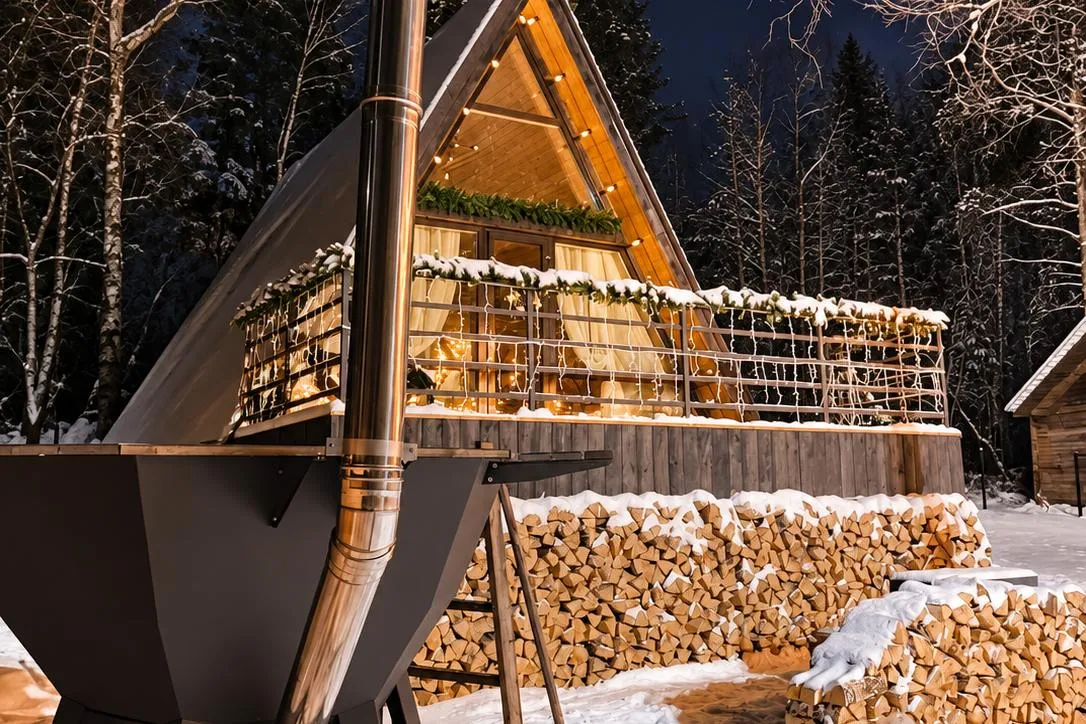
A wood-fired tub next to a cabin, with the firewood stacked close by.
Room for the fire. Keep the stove and chimney clear of overhanging branches, walls, and anything that burns. Your stove’s manual and local code set the distances.
Room to work. Leave space to reach the stove door, a dry spot for firewood, and a path to drain water somewhere sensible.
Check the rules first. Before you buy, ask three questions locally:
- Does my town or county need a permit for a hot tub or an outdoor wood-burning appliance?
- Are there burn bans or fire-season restrictions where I live?
- If I have an HOA, does it allow outdoor wood burning?
Rules vary a lot from place to place. This is general information, not legal advice.
Safety
A wood-fired tub is simple, and its risks are simple too.
- Stir before you get in. The top layer is hotter than the bottom.
- Check the thermometer. The US Consumer Product Safety Commission advises that hot tub water should never exceed 104°F.
- Never light the stove without water in the tub. Firing a dry tub can damage it and can produce scalding steam.
- Keep the fire outside. Never use a wood-fired tub in an enclosed space; the smoke carries carbon monoxide.
- Mind the hot metal. The stove door, chimney, and steel near the fire get hot.
- Watch children near the tub and the stove, always.
- Go easy on alcohol, and get out if you feel dizzy or unwell.
What it costs
In the US in 2026, wood-fired hot tubs fall into three rough bands, based on our team’s analysis of publicly listed prices and warranties.
| Price band | What you typically find |
|---|---|
| Under $5,000 | Entry level. Often sold through big online marketplaces. Thinner shells or softwood, warranties as short as six months. |
| $5,000–10,000 | Most of the established makers, from Canada and Northern Europe. Warranties vary widely — from one year to 30. |
| $10,000+ | Large-capacity models, and packages that include installation. |
What drives the price:
- Material — stainless steel and marine-grade aluminum cost more than softwood.
- Size — more water, more material.
- The stove — its build and how well it moves heat into the water.
- Warranty and support — read what’s covered and for how long.
- Extras — a lid, steps, a mixing paddle.
A cheaper tub isn’t always a bad tub, and an expensive one isn’t always better. Look at the material, the warranty, and whether the company answers questions before you buy.

A wood-fired tub is made for slow evenings.
Is it right for you?
A wood-fired tub suits you if:
- You enjoy the small ritual of lighting a fire and waiting for it.
- You want a tub that runs without electricity — at a cabin, off the grid, or far from the house.
- You’d rather have a few simple parts than pumps and control boards.
- You like soaking in cold weather.
It probably isn’t for you if:
- You want hot water on demand every evening.
- You want jets.
- Burning wood isn’t allowed where you live.
At home, a wood-fired tub is often the last piece of a hot-and-cold routine. Often our customers already have a sauna or a cold plunge; the tub rounds it out, so the whole evening happens a few steps from the back door.
For rentals and glamping sites, a tub is something guests can’t get at home, and it needs no power at remote sites. Some hosts build it into the nightly rate; others offer it as a paid extra. Industry data points the same way: Sage Outdoor Advisory’s 2026 market overview found that US glamping properties with hot tubs average $49 more per night than those without (via International Glamping Business). That’s a comparison, not a promise — location and season matter more. A steel tub suits this kind of regular use: it stands up to seasons and can sit empty between bookings. Plan for the heat-up time and a fresh fill between guests. More on our page for businesses.
Questions people ask
Do wood-fired hot tubs have jets or bubbles?
No. There’s no pump or blower. The water is still, and it’s quiet.
Do wood-fired hot tubs need electricity?
No. The fire heats the water, and the water circulates by itself.
Do wood-fired hot tubs need chemicals?
Usually not, because the water is changed every few soaks. Rentals need more care — see water care.
How hot does a wood-fired hot tub get?
As hot as you let it. Keep it at 104°F or below, and use a thermometer.
How long does the water stay hot?
Not long without a fire. In a steel tub with uninsulated walls, the water starts to cool almost as soon as the fire dies — so keep a small fire going while you soak. Between sessions, an insulated lid slows the loss.
How long does a wood-fired hot tub last?
Stainless steel tubs last decades with basic care. In our analysis of public listings, warranties on wooden tubs run from one year to 30 years, so read them closely: many of the parts are wood, and a tub usually stands outdoors, in all weather.
Can you use it in the rain or snow?
Yes. A soak in falling snow is one of the best reasons to own one.
Can I build my own?
People do, from stock tanks and coil heaters. A purpose-built tub is safer and lasts longer, but a home build is a real option if you’re handy. Check your local rules first, and treat the safety points above as non-negotiable.
Want to see what this looks like in practice? Browse our hot tubs or, if you run a rental, visit our page for businesses.